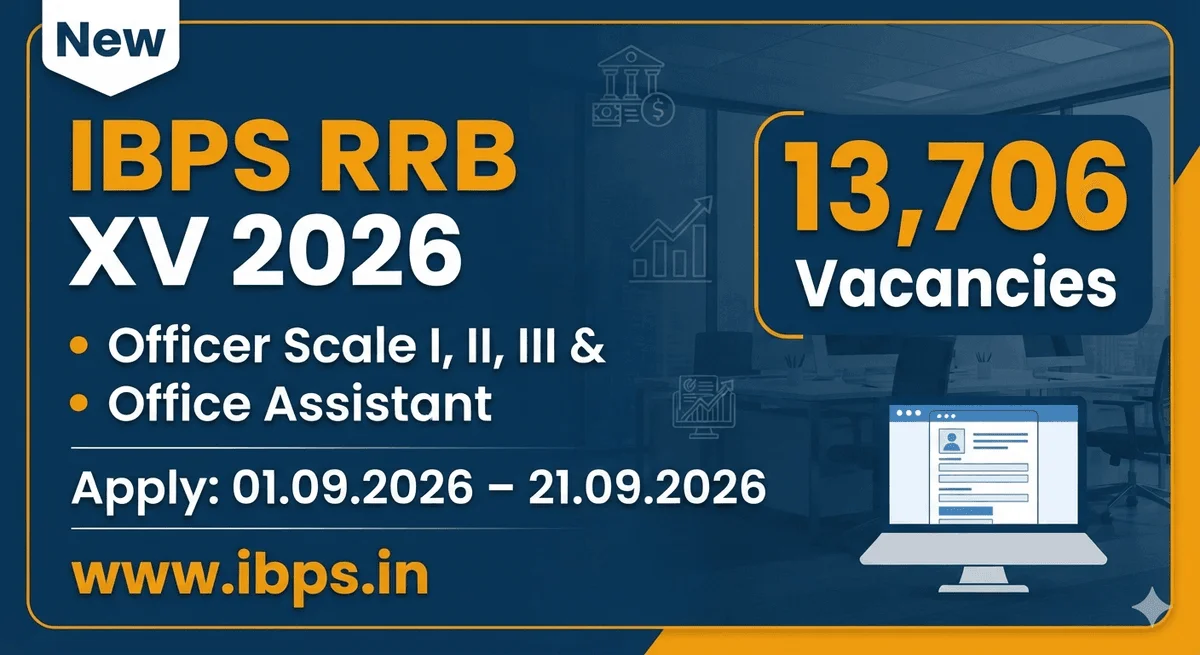
The Institute of Banking Personnel Selection (IBPS) has released the CRP RRBs XV Notification 2026 for recruitment of Group "A" Officers (Scale-I, II & III) and Group "B" Office Assistants (Multipurpose) in 28 Regional Rural Banks (RRBs) across India. The online application process starts on 1 September 2026 and closes on 21 September 2026. Eligible graduates can apply online at the official website www.ibps.in.
Table of Contents
IBPS RRB XV 2026 OverviewImportant DatesVacancy Details Post-wiseEligibility CriteriaApplication FeeSelection ProcessExam PatternHow to Apply for IBPS RRB XV 2026Pre-Exam Training PETKey Points to RememberThis year's recruitment covers approximately 13,706 indicative vacancies — 8,183 for Office Assistant (Multipurpose), 4,256 for Officer Scale-I, 1,047 for Officer Scale-II (Generalist and Specialists), and 220 for Officer Scale-III. Tripura Gramin Bank's vacancies are marked "Not Reported" and will be added later, so the final count may go up.IBPS RRB XV 2026 – OverviewParticularsDetailsRecruiting BodyInstitute of Banking Personnel Selection (IBPS)Exam NameCRP RRBs XVPostsOfficer Scale-I, II, III & Office Assistant (Multipurpose)Total Vacancies13,…