

Squares and cubes are foundational concepts in mathematics that appear everywhere from basic arithmetic to advanced calculations in competitive exams. Mastering them helps you solve problems faster, especially in quantitative aptitude sections of SSC, IBPS, RRB, UPSC, and Railway exams.
What is a Square?
When a number is multiplied by itself, the result is called its square. If a number is n, its square is written as n² (read as "n squared" or "n raised to the power 2").
Formula: n² = n × n
Example: 5² = 5 × 5 = 25
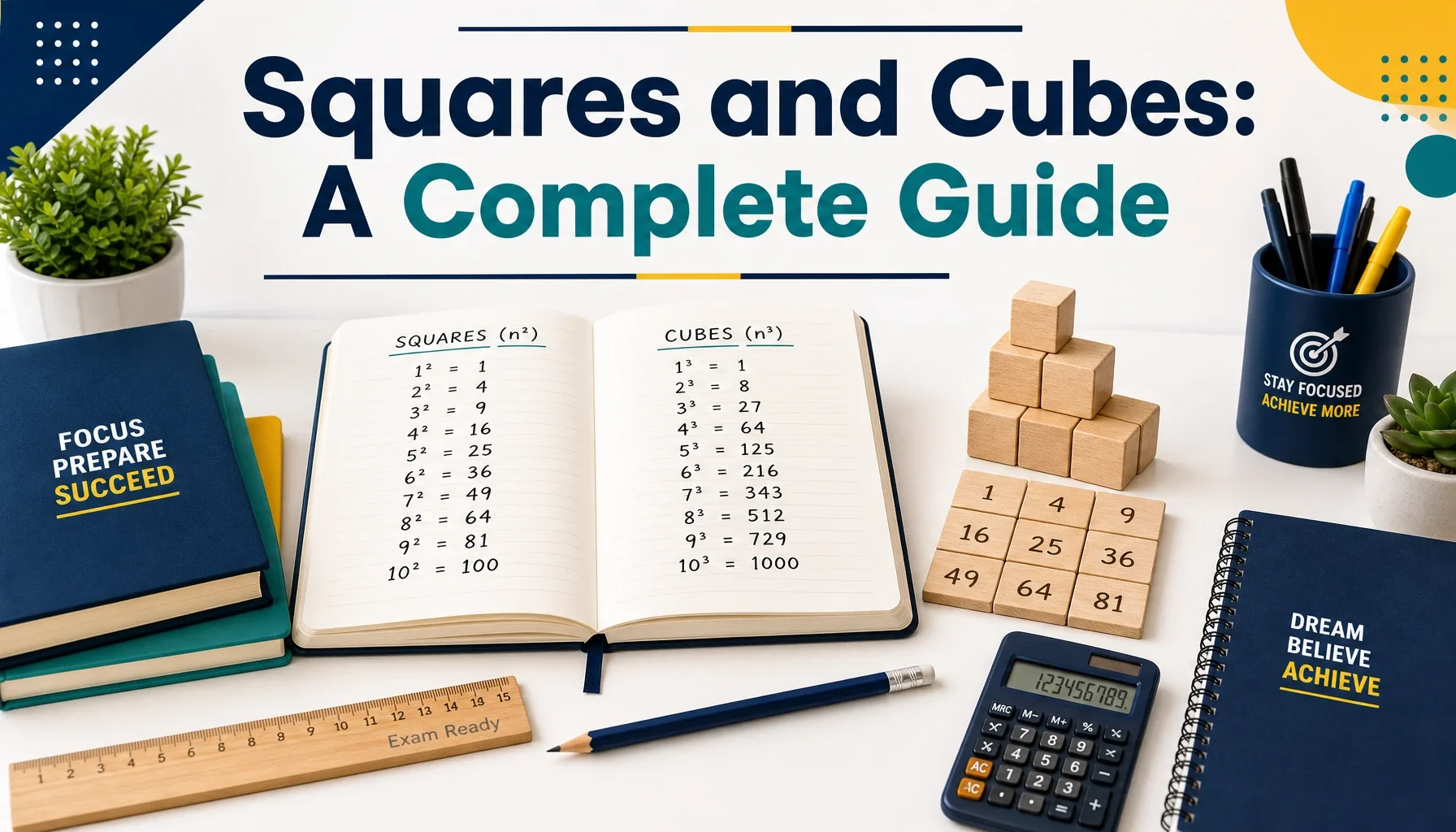
The term "square" comes from geometry — the area of a square with side n equals n². So a square with sides of 5 units has an area of 25 square units.
What is a Cube?
When a number is multiplied by itself three times, the result is its cube. If a number is n, its cube is written as n³ (read as "n cubed" or "n raised to the power 3").
Formula: n³ = n × n × n
Example: 4³ = 4 × 4 × 4 = 64
The term "cube" also comes from geometry — the volume of a cube with edge n equals n³. A cube with edges of 4 units has a volume of 64 cubic units.
Perfect Squares and Perfect Cubes
A perfect square is a number that is the square of an integer (for example, 1, 4, 9, 16, 25). A perfect cube is a number that is the cube of an integer (for example, 1, 8, 27, 64, 125).
Squares Table (1 to 30)
| Number | Square | Number | Square |
|---|---|---|---|
| 1 | 1 | 16 | 256 |
| 2 | 4 | 17 | 289 |
| 3 | 9 | 18 | 324 |
| 4 | 16 | 19 | 361 |
| 5 | 25 | 20 | 400 |
| 6 | 36 | 21 | 441 |
| 7 | 49 | 22 | 484 |
| 8 | 64 | 23 | 529 |
| 9 | 81 | 24 | 576 |
| 10 | 100 | 25 | 625 |
| 11 | 121 | 26 | 676 |
| 12 | 144 | 27 | 729 |
| 13 | 169 | 28 | 784 |
| 14 | 196 | 29 | 841 |
| 15 | 225 | 30 | 900 |
Cubes Table (1 to 30)
| Number | Cube | Number | Cube |
|---|---|---|---|
| 1 | 1 | 16 | 4096 |
| 2 | 8 | 17 | 4913 |
| 3 | 27 | 18 | 5832 |
| 4 | 64 | 19 | 6859 |
| 5 | 125 | 20 | 8000 |
| 6 | 216 | 21 | 9261 |
| 7 | 343 | 22 | 10648 |
| 8 | 512 | 23 | 12167 |
| 9 | 729 | 24 | 13824 |
| 10 | 1000 | 25 | 15625 |
| 11 | 1331 | 26 | 17576 |
| 12 | 1728 | 27 | 19683 |
| 13 | 2197 | 28 | 21952 |
| 14 | 2744 | 29 | 24389 |
| 15 | 3375 | 30 | 27000 |
Properties of Squares
The square of an even number is always even, and the square of an odd number is always odd. A perfect square always ends in 0, 1, 4, 5, 6, or 9 — never in 2, 3, 7, or 8. The square of a number ending in 5 always ends in 25 (for example, 25² = 625, 35² = 1225). Squares are never negative, since multiplying two negatives gives a positive.
Properties of Cubes
The cube of a positive number is positive, and the cube of a negative number is negative (for example, (−3)³ = −27). The cube of an even number is even, and the cube of an odd number is odd. Unlike squares, cubes can end in any digit from 0 to 9.
Quick Tricks for Exams
Squaring numbers ending in 5: For a number ending in 5, multiply the first digit by the next higher number, then attach 25. Example: For 65², multiply 6 × 7 = 42, then attach 25 → 4225.
Difference of consecutive squares: The difference between the squares of two consecutive numbers equals their sum. For example, 8² − 7² = 64 − 49 = 15, which equals 8 + 7.
Sum of first n odd numbers: The sum of the first n odd numbers equals n². For example, 1 + 3 + 5 + 7 = 16 = 4².
Squares vs Cubes: Key Differences
| Aspect | Square | Cube |
|---|---|---|
| Power | 2 (n²) | 3 (n³) |
| Operation | n × n | n × n × n |
| Geometry | Area | Volume |
| Sign of negatives | Always positive | Keeps the sign |
| Last digit options | 0,1,4,5,6,9 | 0–9 (any) |
| Example (n=3) | 9 | 27 |
Conclusion
Squares and cubes are simple yet powerful tools in mathematics. Memorizing the squares up to 30 and cubes up to 20 gives a strong advantage in competitive exams, where speed and accuracy matter most. Practice the tricks regularly, and these calculations will become second nature.
Squares and cubes are foundational concepts in mathematics that appear everywhere from basic arithmetic to advanced calculations in competitive exams. Mastering them helps you solve problems faster, especially in quantitative aptitude sections of SSC, IBPS, RRB, UPSC, and Railway exams.
What is a Square?
When a number is multiplied by itself, the result is called its square. If a number is n, its square is written as n² (read as "n squared" or "n raised to the power 2").
Formula: n² = n × n
Example: 5² = 5 × 5 = 25
The term "square" comes from geometry — the area of a square with side n equals n². So a square with sides of 5 units has an area of 25 square units.
What is a Cube?
When a number is multiplied by itself three times, the result is its cube. If a number is n, its cube is written as n³ (read as "n cubed" or "n raised to the power 3").
Formula: n³ = n × n × n
Example: 4³ = 4 × 4 × 4 = 64
The term "cube" also comes from geometry — the volume of a cube with edge n equals n³. A cube with edges of 4 units has a volume of 64 cubic units.
Perfect Squares and Perfect Cubes
A perfect square is a number that is the square of an integer (for example, 1, 4, 9, 16, 25). A perfect cube is a number that is the cube of an integer (for example, 1, 8, 27, 64, 125).
Squares Table (1 to 30)
| Number | Square | Number | Square |
|---|---|---|---|
| 1 | 1 | 16 | 256 |
| 2 | 4 | 17 | 289 |
| 3 | 9 | 18 | 324 |
| 4 | 16 | 19 | 361 |
| 5 | 25 | 20 | 400 |
| 6 | 36 | 21 | 441 |
| 7 | 49 | 22 | 484 |
| 8 | 64 | 23 | 529 |
| 9 | 81 | 24 | 576 |
| 10 | 100 | 25 | 625 |
| 11 | 121 | 26 | 676 |
| 12 | 144 | 27 | 729 |
| 13 | 169 | 28 | 784 |
| 14 | 196 | 29 | 841 |
| 15 | 225 | 30 | 900 |
Cubes Table (1 to 30)
| Number | Cube | Number | Cube |
|---|---|---|---|
| 1 | 1 | 16 | 4096 |
| 2 | 8 | 17 | 4913 |
| 3 | 27 | 18 | 5832 |
| 4 | 64 | 19 | 6859 |
| 5 | 125 | 20 | 8000 |
| 6 | 216 | 21 | 9261 |
| 7 | 343 | 22 | 10648 |
| 8 | 512 | 23 | 12167 |
| 9 | 729 | 24 | 13824 |
| 10 | 1000 | 25 | 15625 |
| 11 | 1331 | 26 | 17576 |
| 12 | 1728 | 27 | 19683 |
| 13 | 2197 | 28 | 21952 |
| 14 | 2744 | 29 | 24389 |
| 15 | 3375 | 30 | 27000 |
Properties of Squares
The square of an even number is always even, and the square of an odd number is always odd. A perfect square always ends in 0, 1, 4, 5, 6, or 9 — never in 2, 3, 7, or 8. The square of a number ending in 5 always ends in 25 (for example, 25² = 625, 35² = 1225). Squares are never negative, since multiplying two negatives gives a positive.
Properties of Cubes
The cube of a positive number is positive, and the cube of a negative number is negative (for example, (−3)³ = −27). The cube of an even number is even, and the cube of an odd number is odd. Unlike squares, cubes can end in any digit from 0 to 9.
Quick Tricks for Exams
Squaring numbers ending in 5: For a number ending in 5, multiply the first digit by the next higher number, then attach 25. Example: For 65², multiply 6 × 7 = 42, then attach 25 → 4225.
Difference of consecutive squares: The difference between the squares of two consecutive numbers equals their sum. For example, 8² − 7² = 64 − 49 = 15, which equals 8 + 7.
Sum of first n odd numbers: The sum of the first n odd numbers equals n². For example, 1 + 3 + 5 + 7 = 16 = 4².
Squares vs Cubes: Key Differences
| Aspect | Square | Cube |
|---|---|---|
| Power | 2 (n²) | 3 (n³) |
| Operation | n × n | n × n × n |
| Geometry | Area | Volume |
| Sign of negatives | Always positive | Keeps the sign |
| Last digit options | 0,1,4,5,6,9 | 0–9 (any) |
| Example (n=3) | 9 | 27 |
Conclusion
Squares and cubes are simple yet powerful tools in mathematics. Memorizing the squares up to 30 and cubes up to 20 gives a strong advantage in competitive exams, where speed and accuracy matter most. Practice the tricks regularly, and these calculations will become second nature.
