
The Department of Posts has issued Notification No. 17-12/2026-GDS dated 20 August 2026 for the Gramin Dak Sevak Online Engagement Schedule-II, July-2026. Candidates across the country are now searching for the India Post GDS vacancy 2026 state wise breakup before choosing a Division.
This is where most applicants lose their chance. A GDS application is not like an SSC or Railway form — you can apply in only one Division for the entire cycle, and the Divisions available to you are decided by which local language you studied in Class 10. Choose the wrong state and the portal will not even show you the vacancies.
Table of Contents
This guide covers the complete circle-wise structure, the state-wise local language requirement that filters your eligibility, the category-wise reservation pattern, and exactly how to pull your own state's vacancy list from the portal.
Is the State-Wise Vacancy List Released?
An important clarification, because a lot of misleading numbers are circulating.
The Schedule-II descriptive notification does not carry a total vacancy figure or a state-wise vacancy count. Annexure-I of the notification is a blank format — it shows the columns in which vacancies will be published (Division name, Office name, Post ID, TRCA, Account/Record Office, Language, PIN Code), with a footnote stating that the division-wise vacancy position will be available on the Portal.
So the authentic state-wise and division-wise vacancy list is published at https://indiapost.gov.in/gdsonlineengagement, and it becomes visible inside the application flow once you select a Division. Figures being quoted on aggregator websites ahead of that are estimates, not official counts.
Treat any "confirmed state-wise vacancy table" published before the portal data goes live as unverified.
India Post GDS Postal Circles — State Wise List
India Post operates through 23 Postal Circles. Each circle covers one or more states and union territories, and each circle is further divided into Divisions where individual GDS posts are notified.
| # | Postal Circle | States / UTs covered |
|---|---|---|
| 1 | Andhra Pradesh | Andhra Pradesh, Yanam |
| 2 | Assam | Assam (including Barak Valley & BTC areas) |
| 3 | Bihar | Bihar |
| 4 | Chhattisgarh | Chhattisgarh |
| 5 | Delhi | NCT of Delhi |
| 6 | Gujarat | Gujarat, Dadra & Nagar Haveli, Daman & Diu |
| 7 | Haryana | Haryana |
| 8 | Himachal Pradesh | Himachal Pradesh |
| 9 | Jammu & Kashmir | J&K, Ladakh |
| 10 | Jharkhand | Jharkhand |
| 11 | Karnataka | Karnataka |
| 12 | Kerala | Kerala, Lakshadweep, Mahe |
| 13 | Madhya Pradesh | Madhya Pradesh |
| 14 | Maharashtra | Maharashtra, Goa |
| 15 | North East | Arunachal Pradesh, Manipur, Meghalaya, Mizoram, Nagaland, Tripura |
| 16 | Odisha | Odisha |
| 17 | Punjab | Punjab, Chandigarh |
| 18 | Rajasthan | Rajasthan |
| 19 | Tamil Nadu | Tamil Nadu, Puducherry (excluding Mahe & Yanam) |
| 20 | Telangana | Telangana |
| 21 | Uttar Pradesh | Uttar Pradesh |
| 22 | Uttarakhand | Uttarakhand |
| 23 | West Bengal | West Bengal, Andaman & Nicobar Islands, Sikkim |
State-Wise Local Language Requirement (The Real Eligibility Filter)
This table decides which state's vacancies you can apply against. You must have studied the prescribed local language at least up to 10th standard from a recognised board.
| Circle | State / Area | Prescribed local language |
|---|---|---|
| Andhra Pradesh | Andhra Pradesh, Yanam | Telugu |
| Assam | Assam (excluding Barak Valley & BTC) | Assamese |
| Assam | Three districts of Barak Valley | Bengali |
| Assam | Bodoland Territorial Council areas | Bodo |
| Bihar | Bihar | Hindi |
| Chhattisgarh | Chhattisgarh | Hindi |
| Delhi | NCT of Delhi | Hindi |
| Gujarat | Gujarat, DNH, Daman & Diu | Gujarati |
| Haryana | Haryana | Hindi |
| Himachal Pradesh | Himachal Pradesh | Hindi |
| Jammu & Kashmir | J&K, Ladakh | Urdu or Hindi |
| Jharkhand | Jharkhand | Hindi |
| Karnataka | Karnataka | Kannada |
| Kerala | Kerala, Lakshadweep, Mahe | Malayalam |
| Madhya Pradesh | Madhya Pradesh | Hindi |
| Maharashtra | Maharashtra | Marathi |
| Maharashtra | Goa | Konkani or Marathi (special provision) |
| North East | Arunachal Pradesh | Hindi or English, plus one of 23 notified dialects |
| North East | Manipur | Manipuri or English |
| North East | Meghalaya (Garo Hills, Sixth Schedule areas) | Hindi or English, and Garo |
| North East | Meghalaya (Khasi/Jaintia Hills, Sixth Schedule areas) | Hindi or English, and Khasi |
| North East | Meghalaya (rest of the state) | Hindi or English |
| North East | Mizoram | Mizo |
| North East | Nagaland | Hindi or English, plus one of 19 tribal dialects |
| North East | Tripura | Bengali or Kak Barak |
| Odisha | Odisha | Odia |
| Punjab | Punjab | Punjabi |
| Punjab | Chandigarh | Hindi or English |
| Rajasthan | Rajasthan | Hindi |
| Tamil Nadu | Tamil Nadu, Puducherry | Tamil |
| Telangana | Telangana | Telugu |
| Uttar Pradesh | Uttar Pradesh | Hindi |
| Uttarakhand | Uttarakhand | Hindi |
| West Bengal | West Bengal | Bengali |
| West Bengal | Andaman & Nicobar Islands | Hindi or English |
| West Bengal | Sikkim | English plus one of 12 notified languages |
| West Bengal | Darjeeling Division | Bengali or Nepali |
| West Bengal | Post offices under GTA | Nepali |
Special Provisions for Four States
Arunachal Pradesh — Candidates need Hindi or English up to 10th standard and one of the 23 tribal languages/dialects notified as third language by the state. Since these dialects are not taught up to Class 10, proficiency is certified by the concerned Deputy Commissioner and must be produced at document verification. Failure to produce it cancels the candidature. This provision runs for five years from 01.03.2024.
Goa — Konkani or Marathi at 10th standard level. A candidate who studied only Marathi must additionally possess proficiency in Konkani, verified through a certificate from Goa Konkani Akademi or another government-authorised body.
Sikkim — English plus any one of 12 languages: Nepali, Bhutia, Lepcha, Limbu, Newari, Rai, Gurung, Mangar, Sherpa, Tamang, Sunuwar or Bhujel, at 10th standard level. If not studied up to Class 10, a Certificate of Proficiency from the Joint Director (Languages & Text Book), Education Department, Government of Sikkim is required.
Nagaland — Hindi or English up to 10th standard plus knowledge of any of the 19 notified tribal dialects: Angami, Ao, Chakhesang, Chang, Garo, Kachari, Khiamniungan, Konyak, Kuki, Lotha, Mikir, Phom, Pochury, Rengma, Sangtam, Sumi, Tikhir, Yimkhiung and Zellang. Proficiency is certified by the concerned District Deputy Commissioner.
Category-Wise Reservation in Each State
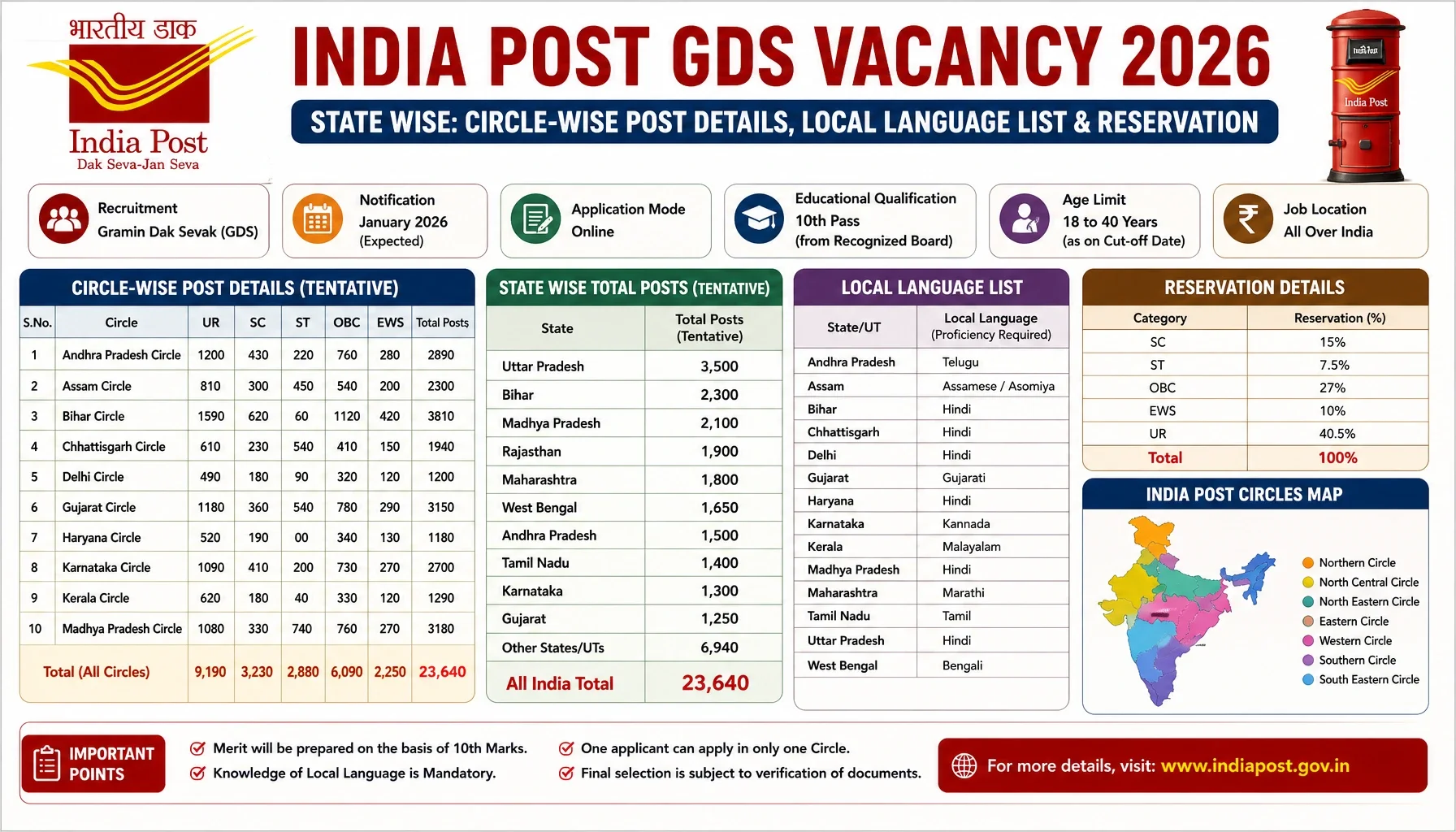
The vacancy consolidation for every Division follows a fixed pattern, given in Annexure-I of the notification:
| Community | Reservation |
|---|---|
| SC | As per state reservation percentage |
| ST | As per state reservation percentage |
| OBC | As per state reservation percentage |
| EWS | 10% |
| PwBD – Low Vision (LV) | 1% |
| PwBD – Deaf / Hard of Hearing | 1% |
| PwBD – OA, OL, Leprosy Cured, Dwarfism, Acid Attack Victim, BL*, Spinal Infirmity/Deformity | 1% |
| PwBD – Specific Learning Disability / Intellectual Disability + Multiple Disabilities | 1% |
| UR | Remaining posts |
Because SC, ST and OBC percentages follow state reservation rosters, the category split for the same number of posts looks very different in Bihar, Tamil Nadu, Rajasthan and the North East. Always read the consolidation table of the specific Division you are applying to, not a national average.
*Candidates with disability in Both Legs (BL) are eligible only for Dak Sevak posts involving both delivery and stationery duties, and if selected against a delivery post, will be posted to a suitable non-delivery assignment.
How to Check Your State's GDS Vacancy List 2026
- Open https://indiapost.gov.in/gdsonlineengagement
- Complete One-Time Registration (31.08.2026 to 19.09.2026) and log in with your registration number
- Fill your Board / Educational Details — circle where you passed SSE, board name, year and marks
- Move to Division selection and post preference
- The portal displays vacancies filtered automatically by your community, age, PwBD status and local language studied
- Give a preference against every Post ID you want to be considered for
Reading the Vacancy Table Correctly
Each row in the published list carries: Division name, Office name, Post ID, TRCA, Account/Record Office, Language and PIN Code.
The Post ID is the field that matters most. Where one office has multiple posts with the same designation, each carries its own Post ID, and a preference must be given against each Post ID separately. Candidates who assume one preference covers all posts in that office silently lose those vacancies.
One Division Only — Choose Carefully
A candidate may apply for one or more vacant GDS posts within only one selected Division. This single rule shapes the entire strategy:
- You will not be considered for any post you did not give a preference for, even if your merit was sufficient.
- If you are meritorious in several preferred posts, only the first post in your preference order for which you are found most suitable is offered. Your claim on every other post is forfeited.
- The ₹100 fee is charged per application, covers all posts in the chosen Division, and is never refunded — including cases where a later edit makes you fee-exempt.
The practical implication: prefer a Division where your Class 10 percentage is likely to clear the cut-off rather than the Division nearest to your home. Divisions in high-competition circles like Uttar Pradesh, Bihar and West Bengal have historically closed at very high percentages, while smaller Divisions in the North East and hill regions close much lower.
Residence Requirement by Post Type
State selection also commits you to a residence condition, and this is enforced before engagement:
- BPM — must arrange accommodation for the Branch Post Office at their own cost and reside in the post village itself. The accommodation must meet the standards prescribed by Directorate letter No. 17-02/2018-GDS dated 08.03.2019.
- ABPM — must reside within the delivery jurisdiction of the Branch Office.
- Dak Sevak — must reside within the delivery jurisdiction of the HO/SO attached to.
Applying to a distant Division without the ability to relocate leads to cancellation at the joining stage, and the post goes to the next candidate on the list.
Key Dates for All States
| Activity | Dates |
|---|---|
| Online One-Time Registration | 31.08.2026 to 19.09.2026 (1700 hrs) |
| Application submission & fee payment | 02.09.2026 to 21.09.2026 (1700 hrs) |
| Correction / edit window | 23.09.2026 to 24.09.2026 (1700 hrs) |
| Last date for issue of shortlists | 31.12.2026 |
Dates are uniform across all circles — there is no separate state-wise schedule.
Frequently Asked Questions
Has the India Post GDS 2026 state-wise vacancy list been released? The descriptive notification does not include state-wise or total vacancy numbers. Division-wise vacancy positions are published separately on the GDS Online Engagement Portal and become visible during Division selection in the application form.
Can I apply for GDS vacancies in two different states? No. A candidate can apply within only one Division across the entire cycle, though multiple post preferences are allowed inside that Division.
Can I apply to another state if I did not study its local language? No. The local language prescribed for that circle must have been studied up to at least 10th standard. The portal filters out vacancies you are not language-eligible for.
Which state has the easiest GDS cut-off? Cut-offs are Division-specific and vary each cycle with the number of posts and applicants. Smaller Divisions with fewer applicants generally close at lower percentages than large Divisions in Uttar Pradesh, Bihar and West Bengal, but no cut-off is fixed in advance.
What is the reservation percentage in each state? SC, ST and OBC follow the reservation percentage of the concerned state. EWS is 10% and PwBD is 1% in each of the five notified sub-categories, uniformly across circles.
Do I need to give a preference for every Post ID? Yes. If an office has several posts with the same name, each has a unique Post ID and a separate preference must be recorded for each one you want.
Important Links
| Resource | Link |
|---|---|
| GDS Online Engagement Portal (vacancy list & apply) | https://indiapost.gov.in/gdsonlineengagement |
| Department of Posts official website | https://www.indiapost.gov.in |
