
SSC CGL Syllabus 2026 at a Glance
Preparing for one of the country's most sought-after central government recruitment drives starts with knowing exactly what you will be tested on. The Staff Selection Commission has rolled out its Combined Graduate Level examination cycle, and understanding the SSC CGL Syllabus 2026 is the single most important step before you begin serious study. This article breaks down every section of the Tier 1 and Tier 2 papers in plain language so you can plan smarter and download the official PDF without confusion.
Table of Contents
| Detail | Information |
|---|---|
| Organization | Staff Selection Commission (SSC) |
| Examination | Combined Graduate Level (CGL) 2026 |
| Resource | Tier 1 & Tier 2 Syllabus and PDF |
| Mode of Exam | Online (Computer Based Test) |
Why the Syllabus Matters for SSC CGL 2026 Notification
The Staff Selection Commission conducts the CGL exam each year to fill a wide range of Group B and Group C posts across various ministries, departments, and offices of the Government of India. Roles such as Assistant Section Officer, Inspector of Income Tax, Auditor, Tax Assistant, and Sub Inspector are filled through this single recruitment. Before candidates rush to apply online, mastering the SSC CGL Syllabus 2026 helps them avoid wasted effort and focus only on what counts in the actual paper.
SSC CGL Tier 1 Syllabus 2026
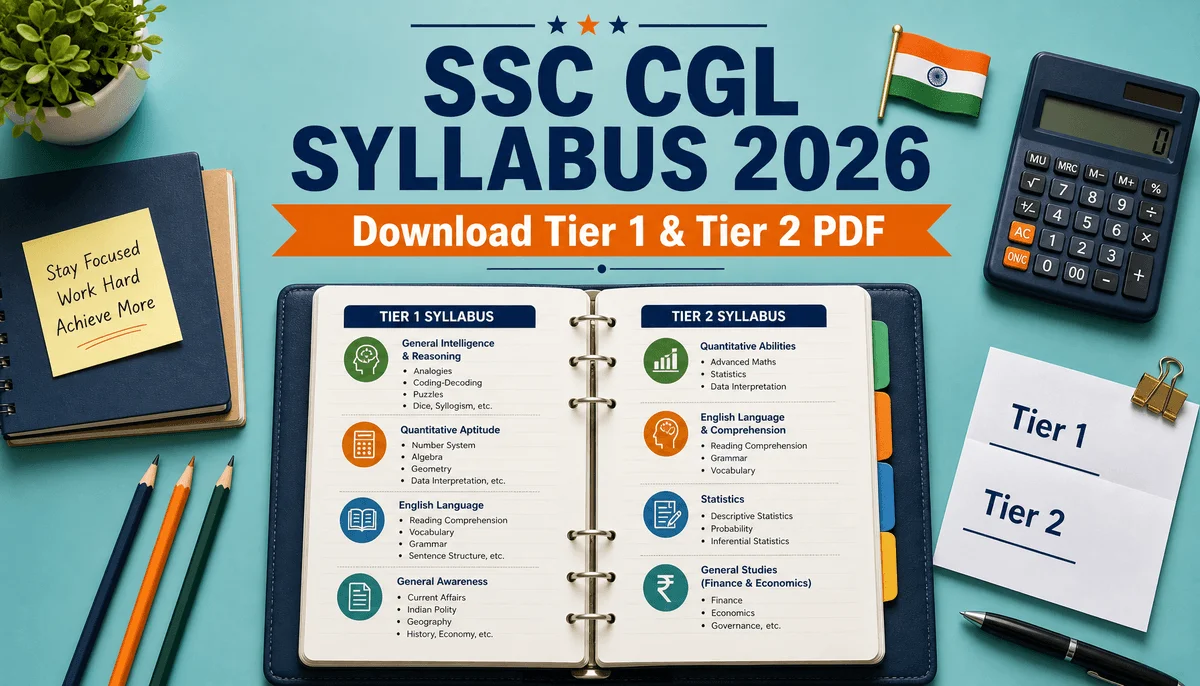
Tier 1 is the qualifying screening stage and is the same for all candidates regardless of the post they target. It is an objective, multiple-choice paper divided into four equally weighted sections. Below is a section-wise breakdown.
1. General Intelligence & Reasoning
This part checks logical thinking and problem-solving ability. Expect questions on analogies, classification, coding-decoding, series completion, blood relations, directions, syllogism, matrix puzzles, mirror images, and non-verbal reasoning patterns.
2. General Awareness
This section measures awareness of the world around you. Topics include Indian history, geography, polity, the Constitution, economics, general science, sports, awards, books and authors, and current affairs of national and international importance.
3. Quantitative Aptitude
Numerical ability is tested through percentages, ratio and proportion, averages, profit and loss, simple and compound interest, time and work, speed and distance, mensuration, algebra, geometry, trigonometry, and data interpretation.
4. English Comprehension
This portion evaluates command over the language with synonyms, antonyms, idioms and phrases, spelling correction, sentence improvement, error spotting, fill in the blanks, cloze tests, and reading comprehension passages.
SSC CGL Tier 2 Syllabus 2026
Candidates who clear Tier 1 move on to Tier 2, which is more detailed and post-specific. It is split across multiple papers and sessions, covering deeper concepts and an additional skill component.
Paper 1 (Compulsory for All)
- Mathematical Abilities: Advanced arithmetic, algebra, geometry, trigonometry, statistics, and probability.
- Reasoning and General Intelligence: Higher-level logical and analytical questions.
- English Language and Comprehension: Grammar, vocabulary, and passage-based questions.
- General Awareness: Static GK plus current events.
- Computer Knowledge Module: Basics of hardware, software, internet, MS Office, and cyber awareness.
- Data Entry Speed Test: A typing-based skill assessment for relevant posts.
Paper 2 and Paper 3
These papers are required only for specific posts. Paper 2 covers Statistics for candidates applying as Junior Statistical Officer, while Paper 3 focuses on General Studies (Finance and Economics) for Assistant Audit Officer and Assistant Accounts Officer positions.
Eligibility Criteria for SSC CGL 2026
Educational Qualification
Applicants must hold a bachelor's degree in any discipline from a recognized university. A few specialized posts, such as Junior Statistical Officer, require a degree with Mathematics or Statistics, while Assistant Audit/Accounts Officer roles may give preference to commerce or finance backgrounds.
Age Limit and Relaxation
The general age band ranges from 18 to 32 years depending on the specific post. Age relaxation is offered as per government rules:
- OBC candidates: 3 years
- SC/ST candidates: 5 years
- Persons with Disabilities: 10 years (with additional category-based extension)
- Ex-servicemen: relaxation as per service norms
Application Fee Structure
| Category | Fee |
|---|---|
| General / OBC | Rs. 100 |
| SC / ST / PwD | Exempted (No Fee) |
| Female Candidates | Exempted (No Fee) |
| Ex-Servicemen | Exempted (No Fee) |
Payment can be made online through net banking, debit card, credit card, or UPI during the apply online window.
Selection Process
The recruitment unfolds in clear stages. First, candidates appear for the Tier 1 computer-based test, which acts as a screening round. Those who qualify proceed to the Tier 2 examination, which carries the major weightage for final selection. After the written stages, there is document verification, and certain posts may involve a skill test such as data entry or typing. Final merit is prepared based on Tier 2 performance.
Salary and Pay Scale
Selected candidates are placed under the 7th Pay Commission pay matrix, with most posts falling under Pay Level 4 to Level 8. Depending on the role, the monthly gross salary typically ranges between Rs. 25,000 and Rs. 1,12,000, along with Dearness Allowance, House Rent Allowance, Transport Allowance, and other central government benefits. Posts like Assistant Audit Officer and Assistant Section Officer in central secretariat offer higher pay levels and faster career growth.
How to Apply Online for SSC CGL 2026
- Visit the official SSC website and register on the OTR (One Time Registration) portal if you have not already.
- Log in using your registration ID and password.
- Open the active SSC CGL 2026 application link.
- Fill in personal, educational, and post-preference details carefully.
- Upload a recent passport-size photograph and signature in the required format.
- Pay the application fee online if applicable to your category.
- Review the entire form to ensure accuracy.
- Submit the form and download or print the confirmation page for future reference.
Remember that the apply online window runs from 22 June 2026 to 29 June 2026, so complete your submission well before the deadline to avoid last-minute server issues.
Important Links
- Apply Online: Available on the official SSC portal during the application period
- Download Tier 1 & Tier 2 Syllabus PDF: Official SSC website notification section
- Official Notification: Released on the SSC CGL recruitment page
- Admit Card: To be uploaded before the exam date
Frequently Asked Questions (FAQ)
Q1. What is covered in the SSC CGL Tier 1 syllabus 2026?
Tier 1 covers four sections: General Intelligence & Reasoning, General Awareness, Quantitative Aptitude, and English Comprehension. All four carry equal importance in the screening stage.
Q2. Is the Tier 2 syllabus the same for every candidate?
Paper 1 of Tier 2 is compulsory for all, but Paper 2 (Statistics) and Paper 3 (Finance and Economics) apply only to candidates who choose specific posts like Junior Statistical Officer or Assistant Audit Officer.
Q3. When does the SSC CGL 2026 apply online window open?
The online application starts on 22 June 2026 and closes on 29 June 2026. Submit your form early to stay safe from technical delays.
Q4. Do female candidates have to pay the application fee?
No. Female applicants, along with SC, ST, PwD, and Ex-servicemen candidates, are exempted from paying the application fee. Only General and OBC male candidates pay Rs. 100.
Q5. Where can I download the official SSC CGL syllabus PDF?
The complete Tier 1 and Tier 2 syllabus PDF is published in the notification section of the official Staff Selection Commission website and can be downloaded for free.
With the eligibility, fee structure, and complete SSC CGL Syllabus 2026 now clear in your mind, you can build a focused study plan and apply online with confidence. Bookmark this page and keep checking the official portal for updates on admit cards and exam dates.
