
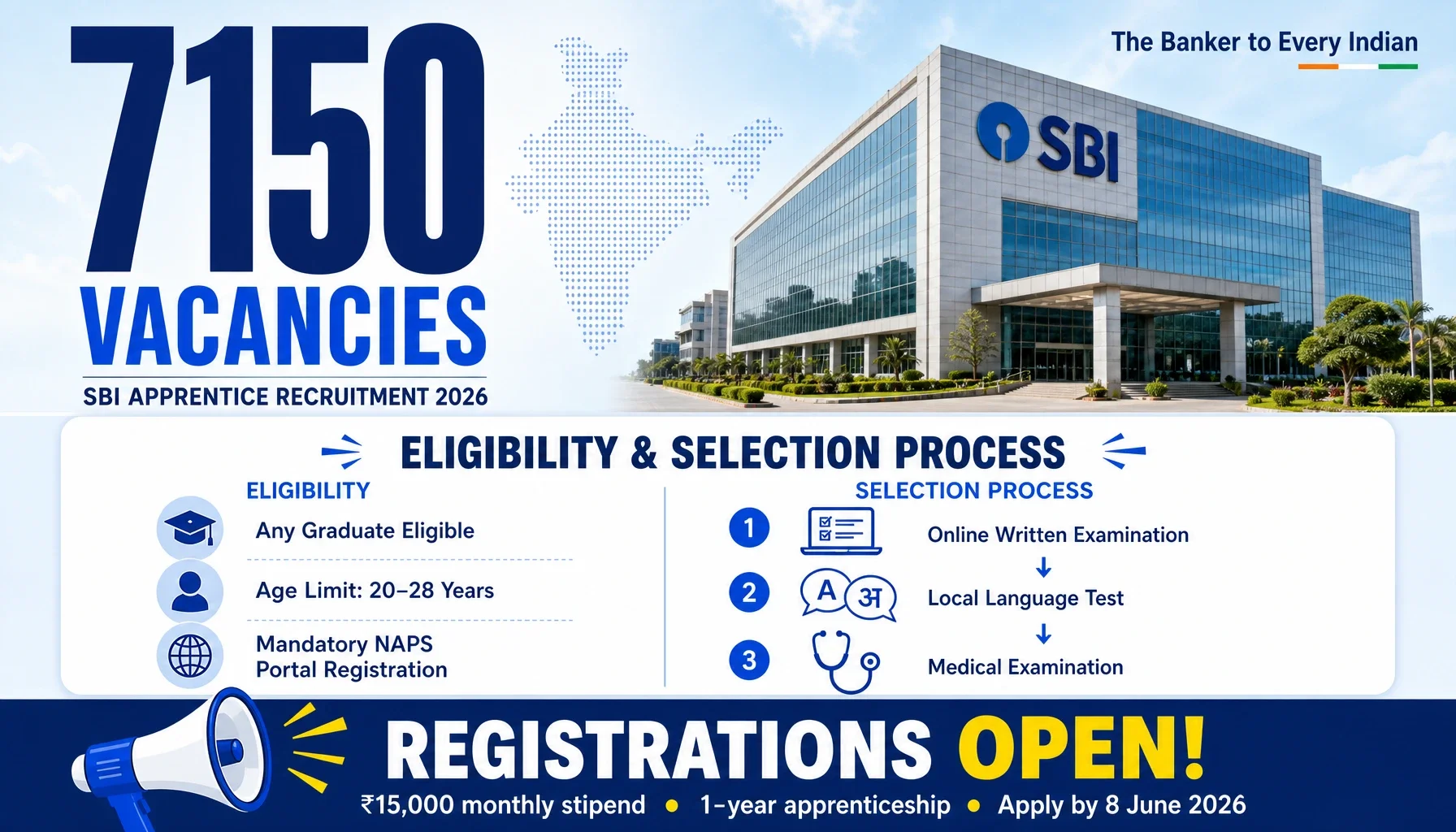
SBI Apprentice 2026 : If you graduated last year and you're staring at a job market that seems to demand five years of experience for an entry-level role, the State Bank of India has just thrown open a window — 7,150 of them, to be precise.
On 19 May 2026, SBI's Central Recruitment & Promotion Department released Advertisement No. CRPD/APPR/2026-27/07, inviting applications from young graduates across India for engagement as apprentices under the Apprentices Act, 1961. The online registration window is short — 19 May to 8 June 2026 — and the examination is tentatively scheduled for July 2026.
This isn't just another government form to fill. For thousands of fresh graduates, this is the most realistic foot-in-the-door into India's banking sector. Let me walk you through what's actually on offer, who can apply, and the parts of this advertisement that most people miss until it's too late.
To be crystal clear about something the notification itself screams in capital letters: this is not a job. It is not contract employment. Apprentices are not "employees" of SBI and do not get employee benefits.
Three reasons. First, you receive a stipend of ₹15,000 per month for the one-year training period — not life-changing, but a real income while you build a CV. Second, you walk away with a joint National Apprenticeship Certificate issued by SBI-NSDC / BFSI-SSC, which is genuine, transferable credential weight. Third, and most importantly, successful apprentices receive weightage and relaxation in the recruitment of Junior Associates — SBI's clerical cadre — as per the bank's recruitment policy. You don't get a guaranteed job, but you do get a measurable head start in the queue.
For graduates who want to test the waters of banking before committing to a career, or who need a structured, paid year to prepare for the IBPS and SBI clerical/PO exams, this is one of the cleanest pathways available.
SBI Apprentice vacancy
The 7,150 seats are distributed across SSC JE 34 states and union territories. The category-wise break-up: 1,107 SC, 586 ST, 1,672 OBC, 699 EWS, and 3,086 unreserved, with horizontal reservation for 304 PwBD candidates (split across VI, HI, LD, and the "d & e" categories that cover autism spectrum disorder, specific learning disability, mental illness, and multiple disabilities).
Some states are dramatically more open than others. Andhra Pradesh leads with 709 seats, followed by Uttar Pradesh (561), Maharashtra (504), Telangana (491), West Bengal (460), Kerala (403), Tamil Nadu (396), and Assam (368). If you live in Manipur (6), Meghalaya (8), Ladakh (15), Chandigarh (15), or Goa (16), the competition will be sharper simply because the seat count is tiny.
A crucial rule that catches many applicants off-guard: you can apply for one state only, and you can appear for this examination only once. Choose strategically. Many candidates instinctively apply in their home state, but if you're fluent in a second regional language and that state has a far better seat-to-applicant ratio, it may pay to think harder before clicking submit.
SBI Apprentice how to Apply
Education: Graduation in any discipline from a recognised university, completed on or before 1 April 2026.
Age: 20 to 28 years as on 1 April 2026 — meaning you should have been born between 2 April 1998 and 1 April 2006 (both inclusive). Reserved-category candidates get the usual relaxations as per Government of India guidelines.
Two disqualifiers that are easy to miss:
- If you have already done an apprenticeship — whether with SBI or any other organisation — you are not eligible. This includes anyone currently undergoing apprenticeship training under the Apprentices Act.
- If you have had any training or job experience of one year or more after obtaining your graduation, you are out. This rule is meant to keep the programme focused on fresh graduates, and it tends to surprise candidates who took up short stints "just to keep busy" after college.
There is no reservation — and government exam no engagement — for ex-servicemen in this apprentice scheme.
The language clause: the part most applicants underestimate
SBI has codified something that many central recruitment exams have moved towards: proficiency in a specified local language of the state you're applying to. The advertisement lists language requirements state-by-state. Andhra Pradesh, for instance, requires Telugu or Urdu; Karnataka requires Kannada; West Bengal requires Bengali or Nepali; Kerala requires Malayalam.
You must be proficient in reading, writing, speaking, and understanding the chosen language. After the online written test, qualifying candidates undergo a separate local language test. The only exemption: if you can produce a Class 10 or Class 12 mark sheet showing you studied the language as a subject, you skip this test entirely.
Failing the language test means your candidature ends, regardless of how well you scored in the written exam. If you're applying outside your home state on the strength of an old school subject, dig out that mark sheet now.
The exam itself
The online written examination is a 60-minute objective test of 100 questions, split into four sections of 25 questions each:
- General / Financial Awareness — 25 marks, 15 minutes
- General English — 25 marks, 15 minutes
- Quantitative Aptitude — 25 marks, 15 minutes
- Reasoning Ability & Computer Aptitude — 25 marks, 15 minutes
Two important mechanics:
Sectional timing. Each section is independently timed — you cannot finish English in 8 minutes and use the extra 7 on Quant. This rewards balanced preparation over a "play to your strengths" approach.
Negative marking. One-fourth of the marks assigned to a question is deducted for each wrong answer. Translation: blind guessing is a losing strategy. Educated elimination between two plausible options is usually still worth it; pure shots in the dark are not.
The question paper will be available in English, Hindi, and 13 regional languages depending on your state — Assamese, Bengali, Gujarati, Kannada, Konkani, Malayalam, Manipuri, Marathi, Odia, Punjabi, Tamil, Telugu, Urdu — except the English section, which is naturally SSLC Result English-only.
Cut-off marks are set by the bank, with the usual 5% relaxation for SC/ST/OBC/PwBD candidates. The merit list is drawn state-wise and category-wise. If two candidates tie at the cut-off, the older candidate ranks higher — an unusual tie-breaker that effectively favours those at the top end of the age band.
Fees and the application mechanics
Application fees are ₹300 for General, OBC, and EWS candidates, and zero for SC, ST, and PwBD candidates. Payment is online only, and once paid, it is not refundable under any circumstances — not even if you decide not to appear.
Before you even start the SBI application form, the notification makes one thing mandatory: register on the NAPS portal at apprenticeshipindia.gov.in first. This is the National Apprenticeship Promotion Scheme portal, and skipping this step will block your SBI registration. Visit bfsissc.com for the detailed step-by-step on the NAPS process.
The actual SBI application is filed at sbi.co.in/careers or sbi.bank.in/web/careers/current-openings. You'll need scanned images of your photograph, signature, left thumb impression, and a handwritten declaration — all in specific dimensions and file sizes (see Annexure-I of the advertisement for exact specifications). You'll also need to capture a live photograph via webcam or mobile during application.
One administrative point worth flagging: you can save and edit your application up to three times before final submission. After final submission, no edits are allowed. Take your time.
District preferences: choose carefully, but don't get attached
When you apply, you'll be asked to select up to three preferred districts within your chosen state. The advertisement contains a detailed district-wise seat distribution — for example, in Andhra Pradesh, NTR district has 97 seats while Alluri Sitharama Raju has 8. In Maharashtra, Mumbai and Mumbai Suburban together account for 90 seats, while Sindhudurg has just 3.
Here's the catch buried in the text: selecting a district does not give you any right to be posted there. The bank explicitly reserves the right to allot you to any district within your selected state, based Eligibility on its administrative requirements. Your three preferences are inputs, not entitlements. Plan your living arrangements accordingly.
The CIBIL clause that surprises many
Tucked into the General Information section is a provision that catches a lot of young candidates off-guard: SBI checks your CIBIL credit record. Candidates who have defaulted on any loan, credit card payment, or other lending obligation — and have not regularised the dues by the time the engagement letter is issued — are not eligible.
If you have an old credit card with unpaid dues from your college days, or an education loan in default, sort it out now. Bring the status current, and ideally get a No-Objection Certificate from the lender to keep on hand. This is the kind of thing that derails candidates after they've already cleared the exam.
Examination centres and what to carry
Examination centres are spread across most major and mid-sized cities in each state. The bank reserves the right to allot you any centre within your chosen state, regardless of preference. No travel expenses are reimbursed — you appear at your own cost.
On exam day, carry one valid photo ID in original (Aadhaar, PAN, passport, driving licence, voter card, or a bank passbook with attested photograph) plus a self-attested photocopy. The photocopy goes to the invigilator. Mobile phones, smartwatches, calculators, earphones, and any electronic device are banned inside the examination premises — there is no safe-keeping facility, so leave them at home or in your vehicle.
The honest verdict
The SBI Apprentice scheme is neither a trap nor a guaranteed ticket. It is what it says it is: a one-year, paid training engagement with India's largest bank, ending in a recognised certificate and a measurable advantage in future SBI Junior Associate recruitment. For graduates aged 20 to 28 with no prior apprenticeship and no other meaningful work experience, it is one of the better risk-reward bets in the public-sector pipeline this year.
The three things that will most often decide whether someone gets in are not raw intelligence — they are: applying in a state where you have a fair seat-to-population ratio and genuine language proficiency, preparing for sectional timing rather than overall timing, and managing the small administrative details (NAPS registration, CIBIL status, language certificate) that get candidates rejected after they've already cleared the test.
The window closes on 8 June 2026. If you're planning to apply, the smartest hour you can spend this week is reading the official advertisement at sbi.co.in/careers end-to-end, in full, with a pen in hand.
Good luck.
