
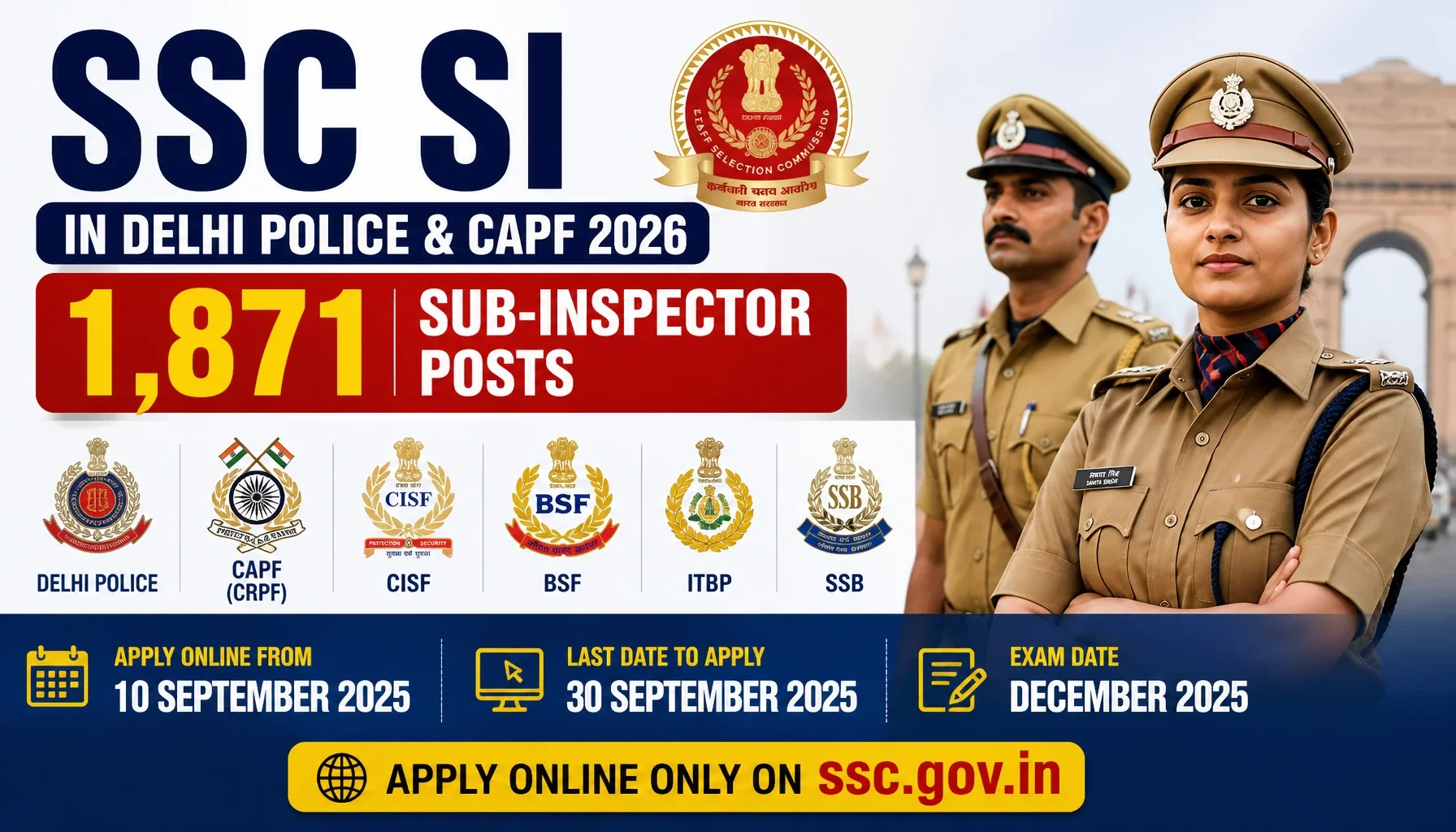
The Staff Selection Commission has released the Sub-Inspector in Delhi Police and Central Armed Police Forces Examination, 2026 notice on 10 September 2026, and it carries the biggest structural change the SSC CPO exam has seen in years. Paper 1 has been cut to half its old size, Paper 2 is no longer an English-only paper, sectional timers have been introduced in both papers, and negative marking in Paper 2 has been doubled to 0.50 marks.
Table of Contents
A new post — Sub-Inspector (Fire) in CISF — has also been added to this recruitment for the first time, with its own age limit and educational qualification.
Below is the complete, notification-based SSC CPO Syllabus 2026 and the new exam pattern for Paper 1 and Paper 2.
SSC CPO 2026 Exam Pattern: What Exactly Changed
| Point | Old Pattern (up to CPO 2025) | New Pattern (CPO 2026) |
|---|---|---|
| Paper 1 questions | 200 questions, 200 marks | 100 questions, 100 marks |
| Paper 1 duration | 2 hours | 1 hour |
| Paper 1 sectional timer | No | Yes — 15 minutes per part |
| Paper 2 subjects | English Language & Comprehension only | 4 parts — Reasoning, GK, Quant + English |
| Paper 2 questions | 200 questions, 200 marks | 160 questions, 320 marks |
| Paper 2 duration | 2 hours | 2 hours (1 hr + 1 hr) |
| Paper 2 sectional timer | No | Yes — 20 minutes each for Parts I, II, III |
| Negative marking | 0.25 in both papers | 0.25 in Paper 1, 0.50 in Paper 2 |
| Marks per question in Paper 2 | 1 mark | 2 marks |
| New post | — | SI (Fire) in CISF added |
The short version: Paper 1 has become a fast screening test, and Paper 2 has become the real merit paper. Paper 2 now carries 320 marks against Paper 1's 100 marks, so the weight of the exam has shifted decisively to the second stage.
SSC CPO Paper 1 Exam Pattern 2026 (New)
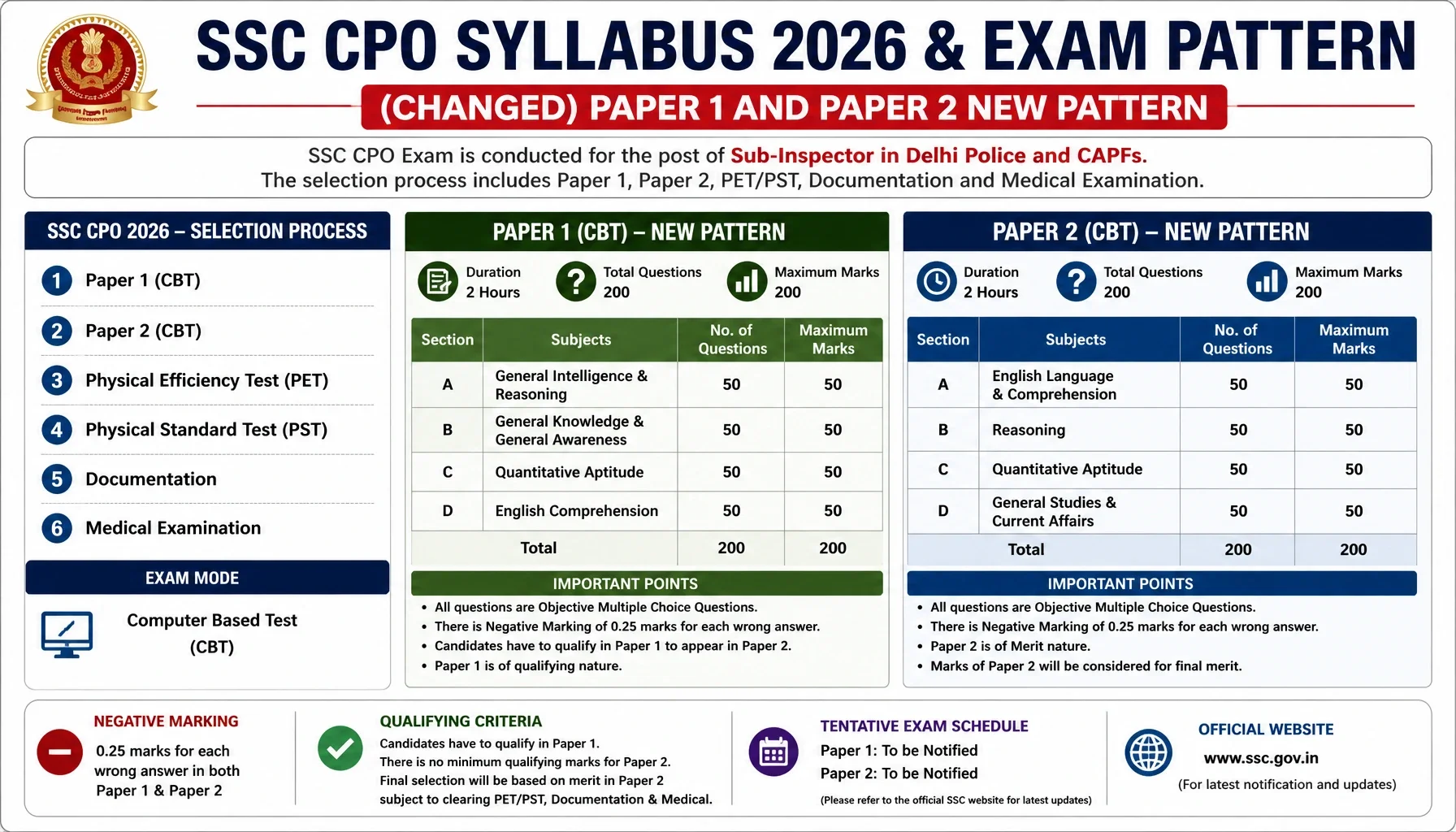
Paper 1 is a computer-based objective test of 100 questions and 100 marks, to be completed in 1 hour with a 15-minute sectional timer for each part.
| Part | Subject | Questions | Marks | Duration |
|---|---|---|---|---|
| I | General Intelligence and Reasoning | 25 | 25 | 15 minutes |
| II | General Knowledge and General Awareness | 25 | 25 | 15 minutes |
| III | Quantitative Aptitude | 25 | 25 | 15 minutes |
| IV | English Comprehension | 25 | 25 | 15 minutes |
| Total | 100 | 100 | 1 Hour |
Key points for Paper 1:
- All questions are objective multiple choice type.
- Questions in Parts I, II and III are set in both Hindi and English. Part IV (English Comprehension) is in English only.
- Negative marking: 0.25 marks for every wrong answer.
- Each part has its own 15-minute timer. Once a part's time is over, you cannot go back to it — the paper moves to the next section automatically.
- If Paper 1 is held in multiple shifts, scores will be normalised using the Commission's procedure notified on 02.06.2025.
- The Commission may fix different cut-offs for each part of Paper 1 while shortlisting for PST/PET.
The 15-minute-per-section rule is the most important practical change. It works out to roughly 36 seconds per question, with no option to borrow time from an easier section. Sectional accuracy now matters more than overall speed.
SSC CPO Paper 2 Exam Pattern 2026 (New)
This is where the pattern has changed the most. Paper 2 is no longer only English. It now has four parts, 160 questions and 320 marks — each question carrying 2 marks.
| Part | Subject | Questions | Marks | Duration |
|---|---|---|---|---|
| I | General Intelligence and Reasoning | 20 | 40 | 20 minutes |
| II | General Knowledge and General Awareness | 20 | 40 | 20 minutes |
| III | Quantitative Aptitude | 20 | 40 | 20 minutes |
| IV | English Comprehension | 100 | 200 | 1 Hour |
| Total | 160 | 320 | 2 Hours |
Key points for Paper 2:
- Parts I, II and III together take 1 hour, with a 20-minute sectional timer for each part.
- Part IV (English Comprehension) is a separate 1-hour block of 100 questions worth 200 marks.
- Negative marking: 0.50 marks for every wrong answer — double the penalty in Paper 1.
- Questions in Parts I, II and III are set in Hindi and English.
- The difficulty level of Paper 2 is higher than Paper 1, as clearly stated in the notice.
- Only candidates who qualify PST/PET are allowed to appear in Paper 2.

English still dominates Paper 2 with 200 of the 320 marks (62.5%), but Reasoning, GK and Quantitative Aptitude now contribute 120 marks at the final stage. Candidates who earlier treated Paper 2 as a pure English paper will have to revise their strategy completely.
SSC CPO Syllabus 2026 (Paper 1 and Paper 2)
The indicative syllabus is the same for both papers — only the difficulty level of Paper 2 is higher.
General Intelligence and Reasoning
Both verbal and non-verbal type questions covering:
Analogies, similarities and differences, space visualization, spatial orientation, problem solving, analysis, judgment, decision making, visual memory, discrimination, observation, relationship concepts, arithmetical reasoning, figural classification, arithmetic number series, non-verbal series, coding and decoding, statement conclusion, syllogistic reasoning.
Specific topics listed in the notice:
- Semantic Analogy, Symbolic/Number Analogy, Figural Analogy
- Semantic Classification, Symbolic/Number Classification, Figural Classification
- Semantic Series, Number Series, Figural Series
- Problem Solving, Word Building
- Coding & Decoding, Numerical Operations, Symbolic Operations
- Trends, Space Orientation, Space Visualization
- Venn Diagrams, Drawing Inferences
- Punched hole / pattern folding & unfolding, Figural pattern folding and completion
- Indexing, Address Matching, Date & City Matching
- Classification of centre codes / roll numbers
- Small & Capital letters/numbers coding, decoding and classification
- Embedded Figures, Critical Thinking, Emotional Intelligence, Social Intelligence
General Knowledge and General Awareness
Questions test general awareness of the environment and its application to society, current events, and everyday observations in their scientific aspect. Coverage includes India and its neighbouring countries, especially:
- History
- Culture
- Geography
- Economic Scene
- General Polity
- Indian Constitution
- Scientific Research
Quantitative Aptitude
Designed to test number sense and the appropriate use of numbers:
- Computation of whole numbers, decimals, fractions and relationships between numbers
- Percentage, Ratio and Proportion, Square roots, Averages
- Interest, Profit & Loss, Discount, Partnership Business
- Mixture and Alligation, Time and Distance, Time & Work
- Basic algebraic identities of School Algebra, Elementary Surds
- Graphs of Linear Equations
- Triangle and its various kinds of centres, Congruence and similarity of triangles
- Circle and its chords, tangents, angles subtended by chords, common tangents to two or more circles
- Triangle, Quadrilaterals, Regular Polygons, Circle
- Right Prism, Right Circular Cone, Right Circular Cylinder, Sphere, Hemispheres, Rectangular Parallelepiped, Regular Right Pyramid with triangular or square base
- Trigonometric ratio, Degree and Radian Measures, Standard Identities, Complementary angles, Heights and Distances
- Histogram, Frequency Polygon, Bar Diagram & Pie Chart
English Comprehension
Tests understanding and knowledge of the English language:
- Error recognition
- Fill in the blanks (verbs, prepositions, articles, etc.)
- Vocabulary and Spellings
- Grammar and Sentence Structure
- Synonyms and Antonyms
- Sentence Completion
- Phrases and Idiomatic use of words
- Comprehension
Since Part IV of Paper 2 alone carries 100 questions and 200 marks, this section deserves the largest share of preparation time — but it can no longer be prepared in isolation.
Minimum Qualifying Marks in Paper 1 and Paper 2
Applied without adding NCC bonus marks:
| Category | Minimum Qualifying Marks |
|---|---|
| UR | 30% |
| OBC / EWS | 25% |
| All other categories | 20% |
NCC Bonus Marks
NCC certificate holders (as on the closing date of applications) get bonus marks in each paper, added to their normalised scores:
| NCC Certificate | Bonus Marks in Each Paper |
|---|---|
| NCC 'C' Certificate | 5% of maximum marks |
| NCC 'B' Certificate | 3% of maximum marks |
| NCC 'A' Certificate | 2% of maximum marks |
With Paper 2 now worth 320 marks, an NCC 'C' certificate is worth 16 bonus marks in Paper 2 alone, plus 5 marks in Paper 1.
SSC CPO 2026 Selection Process
All four stages are mandatory:
- Paper 1 (Computer Based Examination)
- Physical Standard Test (PST) / Physical Endurance Test (PET) — qualifying, no marks
- Paper 2 (Computer Based Examination)
- Detailed Medical Examination (DME) — mandatory but qualifying in nature
Final selection and allocation of Post/Force is made on the basis of performance in Paper 2 (including NCC bonus marks) and the preference of Posts/Forces exercised by the candidate. Once a candidate is allotted the first available preference as per merit, they are not considered for any other option — so preferences must be filled very carefully.
Tie-Breaking Rules
Where candidates secure equal aggregate marks in Paper 1 + Paper 2, ties are resolved in this order:
- Total marks in Paper 2
- Marks obtained in English in Paper 2
- Date of birth — older candidate placed higher
- Alphabetical order of names
Physical Standard Test (PST) 2026
Height and Chest for SI in Delhi Police
| Category | Height (cm) | Chest Unexpanded | Chest Expanded |
|---|---|---|---|
| Male (general) | 170 | 80 | 85 |
| Male — Hill areas of Garhwal, Kumaon, Himachal Pradesh, Gorkhas, Dogras, Marathas, Kashmir Valley, Leh & Ladakh, North-Eastern States and Sikkim | 165 | 80 | 85 |
| Male — Scheduled Tribes | 162.5 | 77 | 82 |
| Female (general) | 157 | — | — |
| Female — Hill areas and listed categories | 155 | — | — |
| Female — Scheduled Tribes | 154 | — | — |
Height and Chest for SI (GD) in CAPFs
| Category | Height (cm) | Chest Unexpanded | Chest Expanded |
|---|---|---|---|
| Male (general) | 170 | 80 | 85 |
| Male — Hill areas of Garhwal, Kumaon, Himachal Pradesh, Dogras, Marathas, Kashmir Valley, Leh & Ladakh, North-Eastern States and Sikkim | 165 | 80 | 85 |
| Male Gorkha candidates | 157 | 80 | 85 |
| Male — Scheduled Tribes (except NE States) | 162.5 | 77 | 82 |
| Male — Scheduled Tribes of North-Eastern States | 157 | 77 | 82 |
| Female (general) | 157 | — | — |
| Female — Hill areas and listed categories | 155 | — | — |
| Female — Scheduled Tribes | 154 | — | — |
Height and Chest for SI (Fire) in CISF
| Category | Height (cm) | Chest Unexpanded | Chest Expanded |
|---|---|---|---|
| Male (general) | 170 | 81 | 86 |
| Male — Hill areas, Gorkhas, Dogras, Marathas, Sikkimies, Leh & Ladakh, Kashmir Valley, North-Eastern States | 165 | 81 | 86 |
| Male — Scheduled Tribes including Mizos and Nagas | 162.5 | 77 | 82 |
Note the higher chest requirement for SI (Fire) — 81 cm unexpanded against 80 cm for the other posts.
Weight: corresponding to height, for all posts. There is no minimum chest requirement for female candidates.
Physical Endurance Test (PET) 2026
For Male Candidates
| Event | Standard |
|---|---|
| 100 metre race | 16 seconds |
| 1.6 km race | 6.5 minutes |
| Long Jump | 3.65 metres in 3 chances |
| High Jump | 1.2 metres in 3 chances |
| Shot Put (16 lbs) | 4.5 metres in 3 chances |
For Female Candidates
| Event | Standard |
|---|---|
| 100 metre race | 18 seconds |
| 800 metre race | 4 minutes |
| Long Jump | 2.7 metres in 3 chances |
| High Jump | 0.9 metres in 3 chances |
PST/PET carries no marks and is purely qualifying/elimination in nature. Ex-Servicemen are exempt from PET but must clear PST, the written papers and the medical standards.
Medical Standards
- Near vision: N6 (better eye) and N9 (worse eye)
- Distant vision: 6/6 (better eye) and 6/9 (worse eye), without glasses or any corrective surgery
- Candidate must not have knock knee, flat foot, varicose vein or squint
- Must possess high colour vision
- Must be in good mental and bodily health, free from any physical defect likely to interfere with duties
Candidates found unfit in DME get a Review Medical Examination (RME), conducted preferably the next day.
SSC CPO 2026 Vacancy Details
Total vacancies: 1,871
| Post | Vacancies |
|---|---|
| Sub-Inspector (Exe.) in Delhi Police — Male | 205 |
| Sub-Inspector (Exe.) in Delhi Police — Female | 112 |
| Sub-Inspector (GD) in CAPFs | 1,320 |
| Sub-Inspector (Fire) in CISF — Male | 234 |
CAPF Force-wise Break-up
| Force | Male | Female | Total | ESM (10%) |
|---|---|---|---|---|
| CRPF | 225 | 29 | 254 | 25 |
| BSF | 435 | 22 | 457 | 46 |
| ITBP | 159 | 28 | 187 | 19 |
| CISF | 200 | 50 | 250 | 25 |
| SSB | 154 | 18 | 172 | 17 |
| Total | 1,173 | 147 | 1,320 | 132 |
Eligibility Criteria
Age Limit (as on 01.08.2026)
| Post | Age Limit | Date of Birth Range |
|---|---|---|
| SI in Delhi Police and SI (GD) in CAPFs | 20–25 years | Born between 02.08.2001 and 01.08.2006 |
| SI (Fire) in CISF | 18–30 years | Born between 02.08.1996 and 01.08.2008 |
Age relaxation: SC/ST — 5 years; OBC — 3 years; Ex-Servicemen — 3 years after deduction of military service. For SI in Delhi Police, widows, divorced women and women judicially separated who are not remarried get relaxation up to 35 years (up to 40 years for the reserved category code).
Educational Qualification (as on closing date of applications)
- SI in Delhi Police and SI (GD) in CAPFs: Bachelor's degree from a recognised university or equivalent. Final-year candidates may apply but must possess the qualification on or before the closing date.
- SI (Fire) in CISF: Bachelor's degree in Science with Physics, Chemistry and Mathematics; OR Matriculation plus a three-year diploma in Mechanical, Civil, Electrical, Automobile, Chemical, Mining, Aeronautical or Telecommunication Engineering from a recognised University, Board or Institution. Higher qualifications such as B.Tech/M.Tech in relevant fields are allowed as value addition, subject to the basic diploma qualification.
Departmental candidates from Delhi Police (Constables, Head Constables and ASIs with a minimum of three years' service, not more than 30 years of age — 33 for OBC and 35 for SC/ST) may also apply against open vacancies of SI (Exe.) in Delhi Police — Male.
SSC CPO 2026 Important Dates
| Event | Date |
|---|---|
| Online application starts | 10.09.2026 |
| Last date to apply | 30.09.2026 (23:00 hrs) |
| Last date for online fee payment | 01.10.2026 (23:00 hrs) |
| Application Correction Window | 08.10.2026 to 10.10.2026 (23:00 hrs) |
| Paper 1 exam date | To be notified later |
Application fee: Rs. 100/-, payable only through online modes — BHIM UPI, Net Banking, or Visa/Mastercard/Maestro/RuPay cards. Women candidates and SC/ST/ESM candidates eligible for reservation are exempt from the fee.
How to Prepare for the New SSC CPO Pattern
1. Treat Paper 1 as a speed test. With 25 questions and 15 minutes per section, there is no time to think twice. Practise section-wise timed drills rather than full 2-hour mocks.
2. Do not skip Reasoning, GK and Quant after Paper 1. This is the single biggest trap in the new pattern. These three subjects reappear in Paper 2 at a higher difficulty level and carry 120 marks — often more than the final margin between selection and rejection.
3. Recalculate your risk on guessing. Paper 2 deducts 0.50 marks per wrong answer while awarding 2 marks per correct answer. A blind guess on a four-option question has an expected value close to zero. Educated elimination is still worth it; random guessing is not.
4. Build English endurance. Part IV is 100 questions in 60 minutes — 36 seconds per question, sustained for an hour, on top of the three sections you have already attempted.
5. Start PET training now. Paper 1 to PST/PET is a short gap, and PET failure eliminates candidates who have already cleared the written stage.
FAQs
Q. Has the SSC CPO exam pattern changed in 2026? Yes. Paper 1 has been reduced to 100 questions and 100 marks in 1 hour with a 15-minute sectional timer. Paper 2 now has four parts with 160 questions and 320 marks, instead of the earlier 200-question English-only paper.
Q. Is SSC CPO Paper 2 still only English? No. Paper 2 now includes General Intelligence and Reasoning (20 questions, 40 marks), General Knowledge and General Awareness (20 questions, 40 marks), Quantitative Aptitude (20 questions, 40 marks) and English Comprehension (100 questions, 200 marks).
Q. What is the negative marking in SSC CPO 2026? 0.25 marks for each wrong answer in Paper 1 and 0.50 marks for each wrong answer in Paper 2.
Q. Is there a sectional timer in SSC CPO 2026? Yes. Paper 1 has a 15-minute timer for each of the four parts. In Paper 2, Parts I, II and III have a 20-minute timer each, and Part IV (English) has a separate 1-hour slot.
Q. What is the total marks of SSC CPO 2026? Paper 1 is 100 marks and Paper 2 is 320 marks. Final merit is prepared on the basis of Paper 2 performance.
Q. Is Paper 1 counted in the final merit? Final selection and post allocation are based on Paper 2 performance including NCC bonus marks. Paper 1 is used to shortlist candidates for PST/PET, and Paper 1 + Paper 2 aggregate is referred to only while resolving ties.
Q. What is the new post added in SSC CPO 2026? Sub-Inspector (Fire) in CISF — 234 male vacancies, with an age limit of 18–30 years and a separate educational qualification requirement.
Q. How many vacancies are there in SSC CPO 2026? A total of 1,871 vacancies — 205 SI (Exe.) Delhi Police Male, 112 SI (Exe.) Delhi Police Female, 1,320 SI (GD) in CAPFs and 234 SI (Fire) in CISF.
